
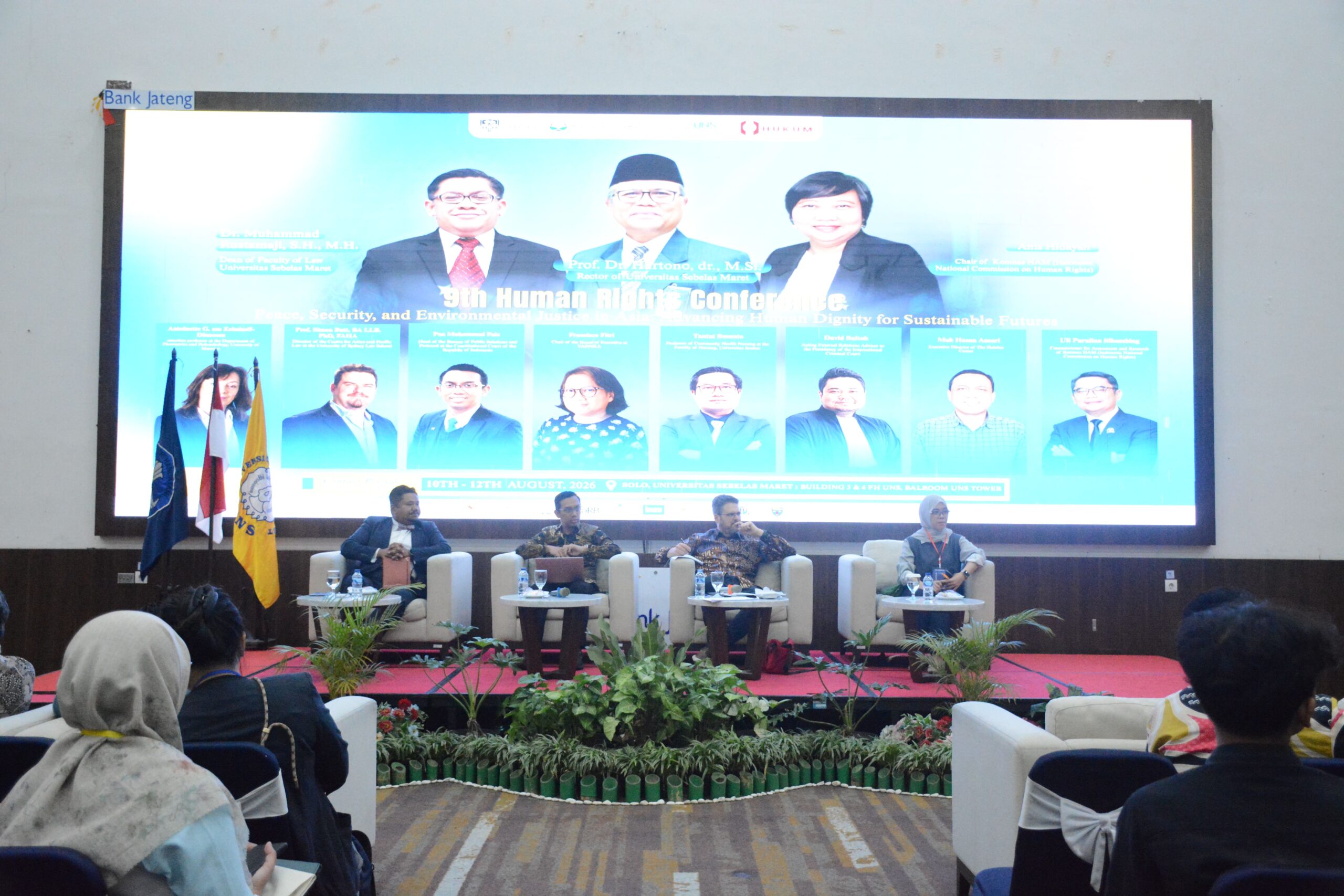
SURAKARTA – Isu Hak Asasi Manusia (HAM), keamanan kawasan, dan keadilan lingkungan kini tidak lagi dapat dipandang sebagai persoalan yang berdiri sendiri. Perubahan iklim, perkembangan teknologi digital, dinamika geopolitik, hingga meningkatnya kerentanan kelompok masyarakat menunjukkan adanya keterkaitan yang semakin kuat antara persoalan keamanan, perlindungan HAM, dan keberlanjutan lingkungan. Menjawab berbagai tantangan tersebut, Universitas Sebelas Maret (UNS) Surakarta menyelenggarakan agenda akademik internasional The 9th Human Rights Conference (9HRC) pada 10–12 Agustus 2026. Berpusat di Ballroom UNS Tower serta Gedung Fakultas Hukum UNS, konferensi ini mempertemukan ratusan akademisi, peneliti, pembuat kebijakan, praktisi, serta pegiat HAM dari 18 yurisdiksi yang terdiri atas Indonesia dan 17 yurisdiksi asing untuk membangun dialog akademik dan merumuskan gagasan strategis bagi terwujudnya masa depan Asia yang damai, aman, adil, dan berkelanjutan.
Rangkaian konferensi diawali dengan Opening Remarks yang disampaikan oleh Komisioner Komnas HAM Anis Hidayah, Dekan Fakultas Hukum UNS Dr. Muhammad Rustamaji, S.H., M.H., serta Rektor UNS yang diwakili oleh Direktur Akademik UNS Prof. Dr. Ir. Sigit Prastowo, S.Pt., M.P., IPM., ASEAN Eng. Pembukaan tersebut menandai dimulainya forum akademik internasional yang mengangkat tema “Peace, Security, and Environmental Justice in Asia: Advancing Human Dignity for Sustainable Futures.” Tema tersebut merefleksikan kebutuhan untuk memperluas pemaknaan terhadap keamanan yang selama ini kerap dikaitkan dengan konflik dan ancaman militer. Dalam konteks perkembangan global saat ini, keamanan juga perlu ditempatkan dalam kerangka pemenuhan hak, keadilan sosial, perlindungan lingkungan, serta kemampuan masyarakat untuk hidup secara bermartabat dan berkelanjutan.


Melalui tema tersebut, 9HRC mendorong perubahan paradigma dalam melihat hubungan antara perdamaian, keamanan, dan keadilan lingkungan di kawasan Asia. Ancaman perubahan iklim, kerusakan lingkungan, ketimpangan sosial, pembatasan kebebasan sipil, serta berbagai bentuk diskriminasi terhadap kelompok rentan memiliki konsekuensi langsung terhadap pemenuhan HAM. Oleh karena itu, upaya membangun keamanan kawasan membutuhkan pendekatan yang lebih komprehensif dengan menempatkan martabat manusia sebagai salah satu fondasi utama. Perspektif lintas disiplin yang melibatkan ilmu hukum, politik, hubungan internasional, pembangunan, lingkungan, serta tata kelola menjadi penting untuk menghasilkan pemahaman yang lebih utuh sekaligus merumuskan respons terhadap persoalan HAM yang semakin kompleks.
Penyelenggaraan The 9th Human Rights Conference diprakarsai oleh tiga convenor utama, yaitu Dr. Erna Dyah Kusumawati dari Fakultas Hukum UNS, Dr. Al Khanif dari Centre for Human Rights, Multiculturalism, and Migration (CHRM2) Universitas Jember, serta Prof. Simon Butt dari Sydney Southeast Asia Centre (SSEAC) University of Sydney. Konferensi ini terlaksana melalui kerja sama konsorsium berbagai lembaga akademik dan institusi yang memiliki perhatian terhadap isu HAM, baik di tingkat nasional maupun internasional. Kolaborasi tersebut melibatkan Fakultas Hukum UNS, CHRM2 Universitas Jember, SSEAC University of Sydney, Komisi Nasional Hak Asasi Manusia (Komnas HAM), SEPAHAM Indonesia, Indonesian Scholar Network on Freedom of Religion or Belief (ISFORB), Nanzan University Jepang, Universiti Malaya Malaysia, serta No Leprosy Remains (NLR).
Keterlibatan berbagai institusi dari dalam dan luar negeri tersebut menunjukkan bahwa persoalan HAM di kawasan Asia membutuhkan kerja sama lintas batas dan lintas disiplin. Forum ini tidak hanya menjadi ruang untuk mempresentasikan hasil penelitian, tetapi juga membuka kesempatan bagi para peserta untuk bertukar perspektif, membangun jejaring akademik, serta mengidentifikasi berbagai persoalan yang dihadapi dalam praktik perlindungan dan pemajuan HAM. Keberagaman latar belakang peserta diharapkan dapat memperkaya diskusi dan mendorong lahirnya gagasan yang tidak hanya relevan secara akademik, tetapi juga memiliki keterhubungan dengan kebutuhan masyarakat dan perkembangan kebijakan di masing-masing negara.
Selama tiga hari pelaksanaan, konferensi menghadirkan rangkaian kegiatan akademik yang dirancang untuk memperluas ruang pertukaran pengetahuan dan pengalaman. Agenda tersebut meliputi workshop penulisan jurnal, diseminasi laporan publikasi, 49 sesi parallel panel sessions yang terbagi ke dalam 14 panel streams, serta tiga Plenary Sessions. Puluhan sesi panel memberikan ruang bagi para akademisi dan peneliti untuk mempresentasikan hasil kajian serta mendiskusikan berbagai isu HAM dari perspektif dan konteks yang beragam. Rangkaian tersebut menjadikan 9HRC sebagai forum yang tidak hanya berorientasi pada penyampaian gagasan, tetapi juga mendorong dialog, kritik akademik, dan pengembangan jejaring penelitian.


Plenary Session 1 mengangkat tema “Access to Justice and The Rule of Court at National and International Context” dengan menghadirkan David Saitoh selaku Acting External Relations Adviser to the Presidency of the International Criminal Court, Dr. Pan Mohamad Faiz dari Mahkamah Konstitusi RI, serta Prof. Simon Butt selaku Director of CAPLUS, University of Sydney Law School. Sesi ini membahas persoalan akses terhadap keadilan dan peran peradilan dalam konteks nasional maupun internasional, sekaligus melihat bagaimana institusi hukum dapat berkontribusi dalam memastikan perlindungan hak dan keadilan bagi masyarakat. Pembahasan tersebut menjadi penting mengingat akses terhadap mekanisme keadilan merupakan salah satu unsur fundamental dalam memastikan bahwa hak-hak individu maupun kelompok dapat terlindungi secara efektif.
Selanjutnya, Plenary Session 2 mengangkat tema “Civil Liberty in the Digital Era: Limits and Challenges” dengan menghadirkan Dr. Uli Parulian Sihombing selaku Komisioner Pengkajian dan Penelitian Komnas HAM serta Fransisca Fitri selaku Chair of Board of Executive YAPPIKA. Perkembangan teknologi digital membawa berbagai peluang bagi kebebasan berekspresi dan partisipasi publik, namun pada saat yang sama juga menghadirkan tantangan baru terhadap perlindungan kebebasan sipil. Diskusi dalam sesi ini menjadi ruang untuk melihat batas, tantangan, serta kebutuhan perlindungan hak asasi dalam ekosistem digital yang terus berkembang. Pembahasan tersebut sekaligus memperlihatkan pentingnya respons hukum dan kebijakan yang mampu mengikuti perkembangan teknologi tanpa mengabaikan prinsip-prinsip HAM.
Sementara itu, Plenary Session 3 mengangkat tema “Eliminating Discrimination Against Vulnerable Group” dengan menghadirkan Prof. Antoinette G. am Zehnhoff-Dinnesen, Emeritus Professor University of Munster & Wakil Presiden German-Indonesian Society for Medicine, Prof. Tantut Susanto selaku Guru Besar Keperawatan Kesehatan Masyarakat Universitas Jember, serta Dr. Mohammad Hasan Ansori selaku Direktur Eksekutif The Habibie Center. Sesi ini memberikan perhatian terhadap berbagai bentuk diskriminasi yang masih dihadapi kelompok rentan dan kebutuhan untuk membangun kebijakan yang lebih inklusif. Pendekatan yang digunakan juga memperluas perspektif HAM dengan menghubungkannya dengan aspek kesehatan, kondisi sosial, serta perlindungan kelompok yang memiliki kerentanan tertentu. Dengan demikian, penghapusan diskriminasi ditempatkan sebagai bagian penting dalam upaya mewujudkan masyarakat yang adil dan bermartabat.
Pada hari ketiga, rangkaian The 9th Human Rights Conference dilanjutkan dengan berbagai sesi akademik dan diskusi yang menjadi ruang untuk memperdalam gagasan serta temuan yang telah dibahas selama konferensi. Seluruh rangkaian kegiatan kemudian ditutup melalui Closing Ceremony & Handover 10th Human Rights Conference yang menjadi momentum refleksi atas pelaksanaan konferensi sekaligus penanda keberlanjutan forum HAM internasional tersebut. Dalam kegiatan ini, dilakukan serah terima penyelenggaraan Human Rights Conference kepada penyelenggara The 10th Human Rights Conference sebagai simbol keberlanjutan kolaborasi dan komitmen bersama dalam mengembangkan kajian serta pemajuan HAM di tingkat nasional, regional, maupun internasional. Penutupan tersebut sekaligus memperkuat semangat untuk menjaga jejaring yang telah terbentuk dan melanjutkan dialog akademik mengenai berbagai tantangan HAM di masa mendatang.


Penyelenggaraan 9HRC juga menjadi bagian dari komitmen UNS dan Fakultas Hukum UNS dalam memperkuat internasionalisasi pendidikan tinggi, pengembangan riset, serta jejaring akademik global. Keterlibatan mitra dari berbagai negara dan institusi menunjukkan upaya membangun kolaborasi yang berkelanjutan dalam pengembangan keilmuan hukum dan HAM. Melalui forum semacam ini, hasil penelitian tidak berhenti pada ruang akademik, tetapi diharapkan dapat dikembangkan menjadi pengetahuan dan rekomendasi yang relevan bagi pemangku kebijakan, lembaga negara, organisasi masyarakat sipil, maupun masyarakat secara lebih luas.
Melalui dialog akademik yang berlangsung selama tiga hari, The 9th Human Rights Conference diharapkan menghasilkan pertukaran pengetahuan, penguatan jejaring penelitian, serta rekomendasi berbasis bukti (evidence-based recommendations) yang dapat berkontribusi terhadap perumusan kebijakan publik dan penguatan perlindungan HAM. Konferensi ini juga menjadi momentum untuk mempertemukan berbagai perspektif dalam mencari pendekatan yang lebih integratif terhadap persoalan perdamaian, keamanan, kebebasan sipil, diskriminasi, dan keadilan lingkungan. Pada akhirnya, 9HRC diharapkan tidak hanya memperkuat posisi UNS sebagai institusi pendidikan tinggi yang berorientasi global, tetapi juga memberikan kontribusi nyata bagi pengembangan wacana dan praktik pemajuan HAM di Indonesia dan kawasan Asia.
9th Human Rights Conference “Peace, Security, and Environmental Justice in Asia: Advancing Human Dignity for Sustainable Futures”
SURAKARTA – The issues of human rights (HAM), regional security, and environmental justice can no longer be viewed as isolated issues. Climate change, the development of digital technology, geopolitical dynamics, and the increasing vulnerability of community groups demonstrate the increasingly strong link between security, human rights protection, and environmental sustainability. Responding to these challenges, Sebelas Maret University (UNS) Surakarta held the 9th Human Rights Conference (9HRC) international academic agenda on August 10–12, 2026. Held in the UNS Tower Ballroom and the UNS Faculty of Law Building, the conference brought together hundreds of academics, researchers, policymakers, practitioners, and human rights activists from 18 jurisdictions, including Indonesia and 17 foreign jurisdictions, to build academic dialogue and formulate strategic ideas for the realization of a peaceful, secure, just, and sustainable future for Asia.
The conference series began with Opening Remarks delivered by National Human Rights Commission Commissioner Anis Hidayah, Dean of the Faculty of Law, UNS Dr. Muhammad Rustamaji, SH, MH, and the UNS Rector represented by the UNS Academic Director Prof. Dr. Ir. Sigit Prastowo, S.Pt., MP, IPM., ASEAN Eng. The opening marked the beginning of the international academic forum with the theme “Peace, Security, and Environmental Justice in Asia: Advancing Human Dignity for Sustainable Futures.” The theme reflects the need to broaden the meaning of security, which has often been associated with conflict and military threats. In the context of current global developments, security also needs to be placed within the framework of the fulfillment of rights, social justice, environmental protection, and the ability of communities to live with dignity and sustainability.
Through this theme, the 9HRC encourages a paradigm shift in viewing the relationship between peace, security, and environmental justice in the Asian region. The threats of climate change, environmental degradation, social inequality, restrictions on civil liberties, and various forms of discrimination against vulnerable groups have direct consequences for the fulfillment of human rights. Therefore, efforts to build regional security require a more comprehensive approach that places human dignity as a key foundation. A cross-disciplinary perspective involving law, politics, international relations, development, the environment, and governance is crucial for generating a more comprehensive understanding and formulating responses to increasingly complex human rights issues.
The 9th Human Rights Conference was initiated by three main convenors : Dr. Erna Dyah Kusumawati from the Faculty of Law, UNS; Dr. Al Khanif from the Center for Human Rights, Multiculturalism, and Migration (CHRM2), University of Jember; and Prof. Simon Butt from the Sydney Southeast Asia Center (SSEAC), University of Sydney. The conference was organized through a collaborative effort by a consortium of academic institutions and institutions concerned with human rights issues, both nationally and internationally. The collaboration involved the Faculty of Law, CHRM2, University of Jember; SSEAC, University of Sydney; the National Commission on Human Rights (Komnas HAM); SEPAHAM Indonesia; the Indonesian Scholar Network on Freedom of Religion or Belief (ISFORB); Nanzan University, Japan; Universiti Malaya, Malaysia; and No Leprosy Remains (NLR).
The involvement of various institutions from within and outside the country demonstrates that human rights issues in the Asian region require cross-border and interdisciplinary collaboration. This forum not only provides a platform for presenting research findings but also provides an opportunity for participants to exchange perspectives, build academic networks, and identify various issues faced in the practice of protecting and promoting human rights. The diversity of participants’ backgrounds is expected to enrich the discussion and encourage the generation of ideas that are not only academically relevant but also connected to societal needs and policy developments in each country.
Over the three days of the conference, a series of academic activities were presented, designed to broaden the space for the exchange of knowledge and experience. The agenda included journal writing workshops , dissemination of published reports, 49 parallel panel sessions divided into 14 panel streams , and three plenary sessions . Dozens of panel sessions provided space for academics and researchers to present their studies and discuss various human rights issues from diverse perspectives and contexts. This series made the 9HRC a forum that not only focused on conveying ideas but also encouraged dialogue, academic critique, and the development of research networks.
Plenary Session 1 raised the theme “Access to Justice and The Rule of Court at National and International Context” by presenting David Saitoh as Acting External Relations Adviser to the Presidency of the International Criminal Court , Dr. Pan Mohamad Faiz from the Constitutional Court of the Republic of Indonesia, and Prof. Simon Butt as Director of CAPLUS, University of Sydney Law School. This session discussed the issue of access to justice and the role of the judiciary in both national and international contexts, while also looking at how legal institutions can contribute to ensuring the protection of rights and justice for the community. This discussion is important considering that access to justice mechanisms is one of the fundamental elements in ensuring that the rights of individuals and groups can be effectively protected.
Furthermore, Plenary Session 2 raised the theme “Civil Liberty in the Digital Era: Limits and Challenges” with Dr. Uli Parulian Sihombing as Commissioner for Studies and Research of the National Human Rights Commission and Fransisca Fitri as Chair of the Executive Board of YAPPIKA. The development of digital technology brings various opportunities for freedom of expression and public participation, but at the same time also presents new challenges to the protection of civil liberties. The discussion in this session provides a space to examine the limits, challenges, and needs for human rights protection in the ever-evolving digital ecosystem. The discussion also demonstrates the importance of legal and policy responses that are able to keep up with technological developments without ignoring human rights principles.
Meanwhile, Plenary Session 3 raised the theme “Eliminating Discrimination Against Vulnerable Groups” by presenting Prof. Antoinette G. am Zehnhoff-Dinnesen, Emeritus Professor of the University of Munster & Vice President of the German-Indonesian Society for Medicine, Prof. Tantut Susanto as Professor of Public Health Nursing at the University of Jember, and Dr. Mohammad Hasan Ansori as Executive Director of The Habibie Center. This session paid attention to the various forms of discrimination still faced by vulnerable groups and the need to build more inclusive policies. The approach used also broadened the perspective of human rights by connecting it with aspects of health, social conditions, and the protection of groups with particular vulnerabilities. Thus, the elimination of discrimination is positioned as an important part of efforts to realize a just and dignified society.
On the third day, the 9th Human Rights Conference continued with various academic sessions and discussions, providing a platform for deepening the ideas and findings discussed during the conference. The entire series of activities concluded with the Closing Ceremony and Handover of the 10th Human Rights Conference , which served as a moment of reflection on the conference’s implementation and a marker of the sustainability of this international human rights forum. The event marked the handover of the Human Rights Conference to the organizers of the 10th Human Rights Conference , symbolizing the continued collaboration and shared commitment to developing human rights studies and advancement at the national, regional, and international levels. The closing ceremony also reinforced the spirit of maintaining the established network and continuing academic dialogue on various human rights challenges in the future.
The 9HRC also represents UNS and the Faculty of Law’s commitment to strengthening the internationalization of higher education, research development, and global academic networks. The involvement of partners from various countries and institutions demonstrates efforts to build sustainable collaboration in the development of legal and human rights scholarship. Through such forums, research findings extend beyond academic boundaries and are expected to be developed into relevant knowledge and recommendations for policymakers, government institutions, civil society organizations, and the broader community.
Through three days of academic dialogue, the 9th Human Rights Conference is expected to generate knowledge exchange, strengthen research networks, and provide evidence -based recommendations that can contribute to the formulation of public policies and strengthen human rights protection. This conference also serves as a momentum to bring together various perspectives in seeking a more integrative approach to issues of peace, security, civil liberties, discrimination, and environmental justice. Ultimately, the 9th Human Rights Conference is expected to not only strengthen UNS’s position as a globally oriented higher education institution but also make a real contribution to the development of discourse and practice of human rights advancement in Indonesia and the Asian region.