
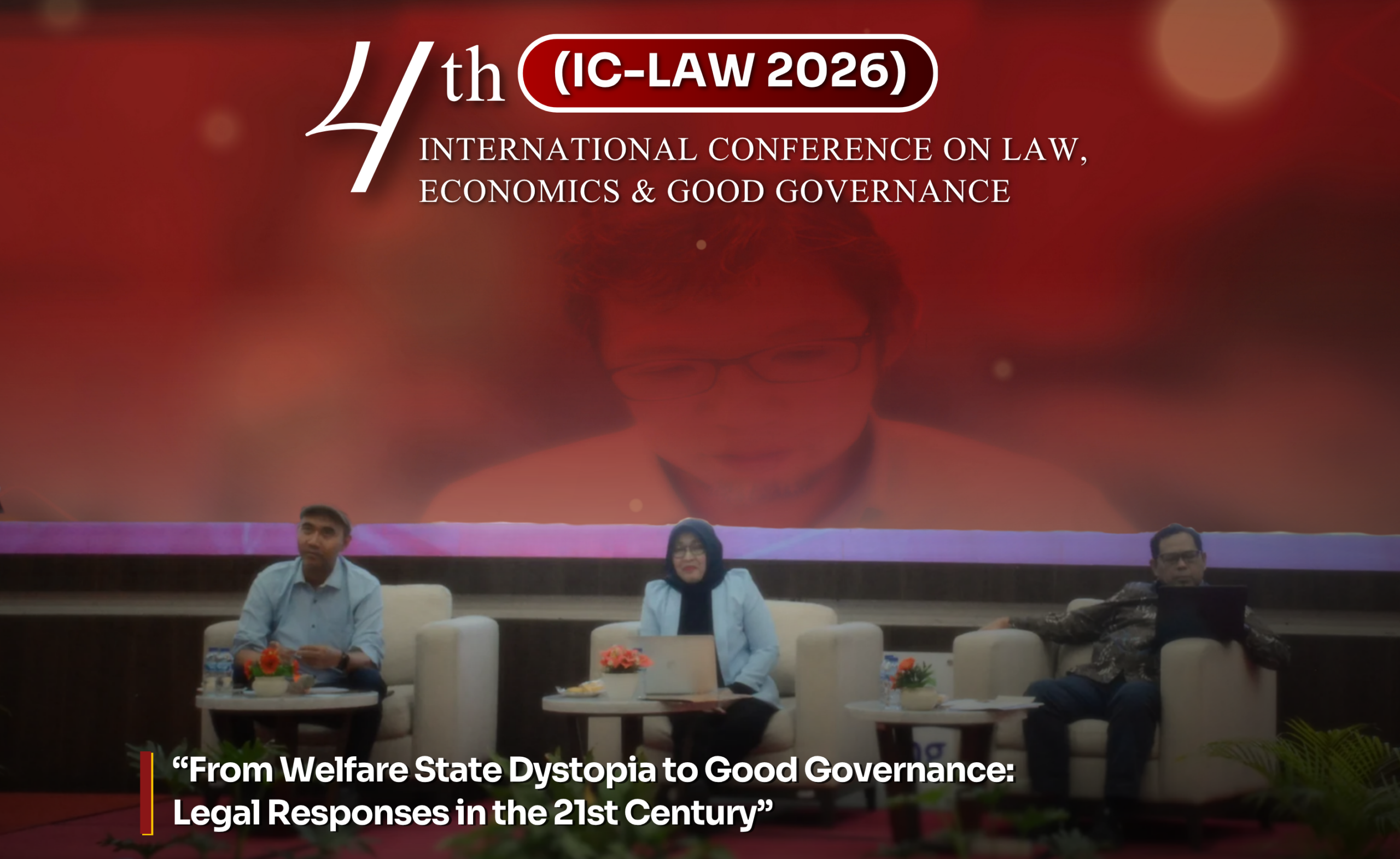
FH UNS — Fakultas Hukum Universitas Sebelas Maret (FH UNS) menyelenggarakan The 4th International Conference on Law, Economics & Good Governance (IC-LAW 2026) pada 29–30 September 2026 di Ballroom UNS Tower, Surakarta. Konferensi internasional ini mengusung tema “From Welfare State Dystopia to Good Governance: Legal Responses in the 21st Century” sebagai ruang akademik untuk membahas perkembangan hukum, ekonomi, dan tata kelola pemerintahan dalam menghadapi tantangan abad ke-21. Kegiatan ini mempertemukan akademisi dan peneliti dari berbagai latar belakang untuk bertukar gagasan serta memperluas perspektif keilmuan melalui diskusi mengenai persoalan hukum kontemporer. Melalui penyelenggaraan konferensi ini, FH UNS mendorong pengembangan penelitian hukum yang relevan dengan dinamika nasional maupun internasional.
Rangkaian kegiatan pada hari pertama diawali dengan sambutan dari Prof. Dr. I Gusti Ayu Ketut Rachmi Handayani, S.H., M.M., selaku Ketua Lembaga Penelitian dan Pengabdian kepada Masyarakat (LPPM) UNS, serta Dr. Sasmini, S.H., LL.M., selaku Wakil Dekan Bidang Akademik dan Penelitian FH UNS. Kegiatan kemudian dilanjutkan dengan pemaparan keynote speaker oleh YM Dr. H. Panji Widagdo, S.H., M.H., yang dalam materi konferensi diperkenalkan sebagai Chief Justice of the Supreme Court of the Republic of Indonesia. Beliau membawakan topik “Court Systems and Artificial Intelligence, Will the Role of Humans Be Replaced?” yang mengangkat diskusi mengenai perkembangan kecerdasan buatan (Artificial Intelligence/AI) dalam sistem peradilan dan kemungkinan perubahan peran manusia dalam proses hukum. Topik tersebut menjadi pengantar bagi pembahasan lebih lanjut mengenai tantangan pemanfaatan teknologi, tata kelola AI, dan kebutuhan untuk menjaga prinsip-prinsip hukum di tengah perkembangan teknologi.


Setelah pemaparan keynote speaker, konferensi memasuki sesi pertama yang dimoderatori oleh Dr. Ir. Bambang Manumayoso, M.H., dosen Hukum Administrasi Negara Fakultas Hukum UNS. Sesi ini menghadirkan dua pembicara yang mengikuti kegiatan secara daring melalui Zoom, yaitu Dr. Cheng-Yun Tsang dan Prof. Dr. Rasyikah Binti MD Khalid, Ph.D. Dr. Cheng-Yun Tsang menyampaikan materi berjudul “A Humanistic Approach to AI Governance: AI Agent Identity in the Financial System in a Dystopian 21st Century” yang membahas pendekatan humanistik dalam tata kelola kecerdasan buatan, khususnya berkaitan dengan identitas agen AI dalam sistem keuangan. Sementara itu, Prof. Dr. Rasyikah Binti MD Khalid, Ph.D. membawakan materi “Balancing the Use of Artificial Intelligence and Its Environmental Impacts in a Dystopian 21st Century” yang mengangkat pentingnya mempertimbangkan dampak lingkungan dalam pemanfaatan kecerdasan buatan.
Setelah kedua pembicara menyampaikan materi, sesi pertama dilanjutkan dengan tanya jawab yang disambut antusias oleh para peserta. Sesi ini memberikan kesempatan kepada peserta untuk mendalami berbagai persoalan terkait tata kelola AI, penerapannya dalam sistem keuangan, serta dampaknya terhadap lingkungan. Interaksi antara pembicara dan peserta turut memperluas ruang pertukaran gagasan mengenai tantangan teknologi dalam konteks hukum dan kehidupan masyarakat. Sesi pertama kemudian diakhiri dengan penyerahan vandel dan sertifikat kepada para pembicara sebagai bentuk apresiasi atas kontribusi mereka dalam konferensi, sebelum kegiatan memasuki waktu istirahat.
Setelah jeda istirahat, seminar dilanjutkan dengan sesi kedua yang dimoderatori oleh Dr. Kukuh Tejomurti, S.H., LL.M. Sesi ini menghadirkan tiga pembicara dengan pembahasan yang berfokus pada hubungan antara kecerdasan buatan, perkembangan hukum, dan perlindungan masyarakat. Pembicara pertama, Prof. Shimada Yuzuru, Ph.D., mengikuti kegiatan secara daring melalui Zoom dan memaparkan materi “Imagining Humanistic Law for Society with Artificial Intelligence in a Dystopian 21st Century”. Materi tersebut mengangkat perspektif mengenai pentingnya pendekatan hukum yang humanistik dalam menghadapi perkembangan masyarakat yang semakin dipengaruhi oleh kecerdasan buatan.
Pembicara berikutnya, Prof. Dr. Topo Santoso, S.H., M.H., menyampaikan materi “Minimizing the Crime of Using Artificial Intelligence by Creating Laws That Protect Society in the Dystopian Era of the 21st Century”. Pembahasan ini menyoroti pentingnya pengembangan regulasi untuk meminimalkan tindak pidana yang berkaitan dengan penggunaan kecerdasan buatan sekaligus memberikan perlindungan kepada masyarakat. Selanjutnya, Prof. Dr. Sunny Ummul Firdaus, S.H., M.H., membawakan topik “Quo Vadis Constitutional Risks and Opportunities of Artificial Intelligence in the Lawmaking Process in a Dystopian 21st Century”. Materi tersebut memperluas pembahasan pada risiko konstitusional dan peluang pemanfaatan AI dalam proses pembentukan peraturan perundang-undangan, termasuk tantangan untuk menjaga prinsip-prinsip konstitusional di tengah perkembangan teknologi.
Setelah seluruh pembicara menyampaikan materi, kegiatan dilanjutkan dengan sesi foto bersama serta penyerahan vandel dan sertifikat kepada para pembicara sebagai bentuk penghargaan atas partisipasi mereka dalam IC-LAW 2026. Rangkaian acara kemudian diteruskan dengan sesi tanya jawab yang memberikan kesempatan kepada peserta untuk menyampaikan pertanyaan dan bertukar pandangan mengenai materi yang telah dipaparkan. Diskusi tersebut menjadi ruang untuk memperdalam pemahaman mengenai tantangan hukum yang muncul seiring dengan penggunaan kecerdasan buatan, mulai dari tata kelola dan perlindungan masyarakat hingga proses pembentukan hukum. Hari pertama konferensi kemudian ditutup dengan makan bersama, mengakhiri rangkaian kegiatan yang mempertemukan beragam perspektif akademik mengenai masa depan hukum dan kecerdasan buatan.


Memasuki hari kedua, Rabu, 30 September 2026, rangkaian IC-LAW 2026 dilanjutkan dengan presentasi artikel ilmiah oleh para peserta. Artikel-artikel yang dipresentasikan sebelumnya telah diunggah sebagai bagian dari rangkaian konferensi, kemudian dibahas melalui sesi paralel yang terbagi ke dalam empat chamber. Setiap chamber memiliki tema dan moderator masing-masing sehingga pembahasan dapat berfokus pada bidang kajian tertentu. Pelaksanaan presentasi ini memberikan kesempatan bagi para penulis untuk memaparkan hasil penelitian sekaligus bertukar pandangan mengenai berbagai persoalan hukum, ekonomi, dan tata kelola pemerintahan.
Chamber pertama mengangkat tema “Digital Technology for Economic Growth” dan berlangsung di Classroom 3, lantai 5, dengan Dr. Solikhah, S.H., M.H. sebagai moderator. Sesi ini membahas berbagai persoalan terkait perkembangan teknologi digital dan kontribusinya terhadap pertumbuhan ekonomi. Topik yang dipresentasikan mencakup transparansi data pelatihan kecerdasan buatan dan tantangan hak cipta, penerapan prinsip keterjelasan algoritma dalam perbankan, serta perlindungan data pribadi dalam penggunaan AI sebagai alat diagnostik. Selain itu, sejumlah artikel membahas peran media siber dalam pertumbuhan ekonomi, kepastian hukum kontrak, tanggung jawab direksi dalam penerapan prinsip ESG pada bank milik negara, serta ruang pengambilan keputusan administratif dalam penetapan kawasan ekonomi khusus.
Chamber kedua bertema “Constitutional and Institutional Governance” diselenggarakan di Meeting Room lantai 7 dan dimoderatori oleh Dr. Fatma Ulfatun Najicha, S.H., M.H. Pembahasan dalam sesi ini berfokus pada tata kelola kelembagaan, hubungan antarpemerintahan, transparansi administrasi, serta penguatan akuntabilitas dalam penyelenggaraan pemerintahan. Artikel yang dipresentasikan antara lain mengkaji kolaborasi pemerintah pusat dan daerah dalam kebijakan satu peta, efisiensi penerbitan sertifikat tanah, penerapan Business Judgment Rule pada badan usaha milik negara, serta pengawasan pengelolaan dana darurat pemerintah daerah. Diskusi juga mencakup audit dana desa, tata kelola badan usaha milik daerah, persoalan penyediaan air minum, partisipasi publik dalam pembentukan peraturan perundang-undangan, keterwakilan gender dalam lembaga legislatif, ambang batas pencalonan presiden, dan reformasi kewenangan dalam sistem peradilan pidana.
Chamber ketiga mengangkat tema “Sustainable Natural Resources Governance in the Era of Climate Change” dan berlangsung di Meeting Room lantai 8 dengan Anugrah Adiastuti, S.H., M.H. sebagai moderator. Sesi ini menyoroti persoalan hukum dan kebijakan dalam pengelolaan sumber daya alam di tengah tantangan perubahan iklim dan tuntutan pembangunan berkelanjutan. Berbagai artikel membahas pengelolaan energi terbarukan, keadilan dalam transisi energi, perlindungan hukum bagi pelaku usaha perkebunan kelapa sawit, serta kepastian hukum dalam pengelolaan sumber daya alam. Topik lainnya mencakup penilaian kerugian negara dalam perkara korupsi lingkungan, pengelolaan bank tanah, instrumen ekonomi untuk perlindungan lingkungan, pembiayaan karbon, perlindungan tanah adat, pengembangan keanekaragaman hayati, serta dampak sosial dan ekologis pengembangan food estate di wilayah masyarakat adat.
Sementara itu, chamber keempat mengusung tema “Contemporary Challenges in Criminal Law” dan diselenggarakan di Private Dining Room lantai 9, dengan Zakki Adlhiyati, S.H., M.H., LL.M. sebagai moderator. Sesi ini membahas berbagai tantangan hukum pidana kontemporer, termasuk pembuktian aset kripto dalam tindak pidana pencucian uang, batas antara tindakan makar dan kebebasan berekspresi, serta partisipasi korban ekologis dalam sistem peradilan pidana. Pembahasan turut mencakup rekonstruksi keadilan restoratif dalam tindak pidana cukai, mekanisme keberatan atas penyitaan dalam perkara perpajakan, serta pemberian pembebasan bersyarat dan remisi bagi terpidana korupsi yang belum mengembalikan kerugian negara. Selain itu, terdapat kajian mengenai kewenangan Jaksa Agung dalam kebijakan penegakan hukum serta rekonstruksi keadilan restoratif dalam penyelesaian perkara pencemaran nama baik melalui media sosial.


Keempat chamber tersebut memperlihatkan luasnya cakupan persoalan yang dibahas dalam IC-LAW 2026, mulai dari transformasi digital dan pertumbuhan ekonomi hingga tata kelola konstitusional, keberlanjutan lingkungan, serta perkembangan hukum pidana. Melalui presentasi dan diskusi akademik, para peserta memperoleh ruang untuk menyampaikan temuan penelitian dan memperluas perspektif terhadap berbagai isu hukum yang berkembang. Keberagaman topik tersebut juga menunjukkan keterkaitan antara hukum, kebijakan publik, perkembangan teknologi, pengelolaan sumber daya alam, dan kebutuhan masyarakat. Sesi presentasi artikel ilmiah menjadi bagian penting dari konferensi dalam mendorong pertukaran pengetahuan serta memperkuat kolaborasi akademik lintas bidang.
Penyelenggaraan IC-LAW 2026 menjadi bagian dari upaya FH UNS dalam memperkuat atmosfer akademik dan memperluas kontribusi institusi terhadap pengembangan ilmu hukum. Melalui konferensi internasional dan presentasi artikel ilmiah, para akademisi dan peneliti memperoleh ruang untuk membahas persoalan aktual dari berbagai sudut pandang serta mengembangkan diskusi yang relevan dengan tantangan abad ke-21. Pertukaran gagasan selama kegiatan diharapkan dapat memperkaya penelitian hukum sekaligus membuka peluang kerja sama akademik yang berkelanjutan. Melalui kegiatan ini, FH UNS terus mendorong pengembangan ilmu hukum yang adaptif, berintegritas, dan berorientasi pada keadilan serta tata kelola pemerintahan yang baik.
FH UNS Gelar The 4th International Conference on Law, Economics & Good Governance (IC-LAW 2026)
FH UNS — The Faculty of Law, Sebelas Maret University (FH UNS) held
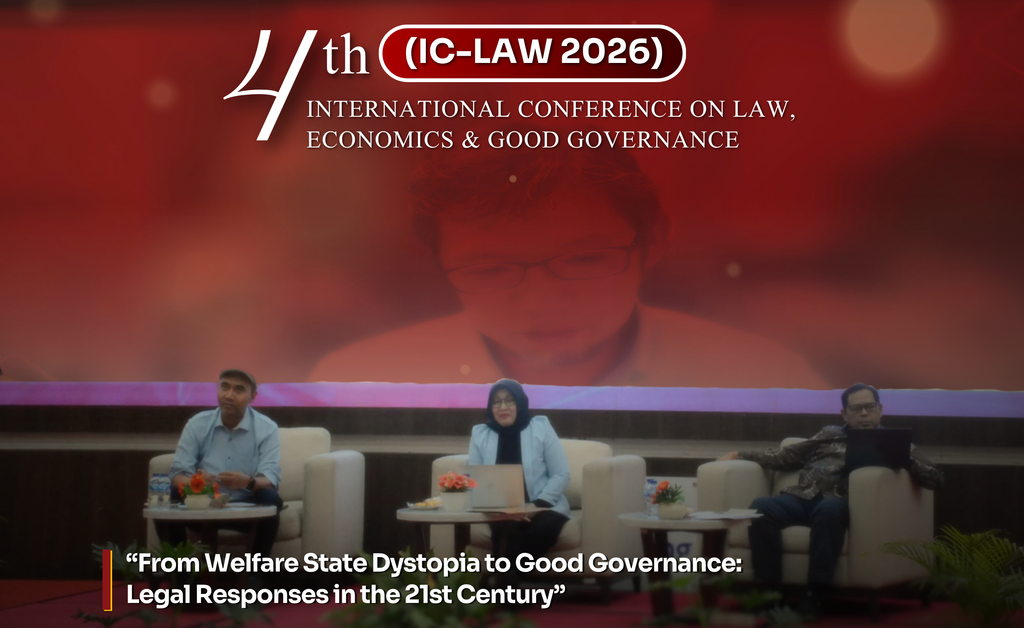
the 4th International Conference on Law, Economics & Good Governance(IC-LAW 2026) on September 29–30, 2026, at the UNS Tower Ballroom, Surakarta. This international conference carried the theme “From Welfare State Dystopia to Good Governance: Legal Responses in the 21st Century” as an academic space to discuss developments in law, economics, and governance in facing the challenges of the 21st century. This activity brought together academics and researchers from various backgrounds to exchange ideas and broaden scientific perspectives through discussions on contemporary legal issues. Through this conference, FH UNS encouraged the development of legal research that is relevant to national and international dynamics.
The series of activities on the first day began with remarks from Prof. Dr. I Gusti Ayu Ketut Rachmi Handayani, SH, MM, as Chair of the UNS Institute for Research and Community Service (LPPM), and Dr. Sasmini, SH, LL.M., as Vice Dean for Academic and Research of the UNS Faculty of Law. The activity then continued with a keynote speaker presentation by HE Dr. H. Panji Widagdo, SH, MH , who in the conference material was introduced as the Chief Justice of the Supreme Court of the Republic of Indonesia . He presented the topic “Court Systems and Artificial Intelligence, Will the Role of Humans Be Replaced?” which raised a discussion about the development of artificial intelligence ( AI ) in the justice system and the possibility of changing the role of humans in the legal process. The topic served as an introduction to further discussions about the challenges of utilizing technology, AI governance, and the need to maintain legal principles amidst technological developments.
After the keynote speaker’s presentation , the conference entered the first session moderated by Dr. Ir. Bambang Manumayoso, MH , a lecturer in Public Administrative Law at the Faculty of Law, UNS. This session presented two speakers who participated online via Zoom, namely Dr. Cheng-Yun Tsang and Prof. Dr. Rasyikah Binti MD Khalid, Ph.D. Dr. Cheng-Yun Tsang delivered a presentation entitled “A Humanistic Approach to AI Governance: AI Agent Identity in the Financial System in a Dystopian 21st Century” which discussed the humanistic approach in artificial intelligence governance, particularly regarding the identity of AI agents in the financial system. Meanwhile, Prof. Dr. Rasyikah Binti MD Khalid, Ph.D. presented the presentation “Balancing the Use of Artificial Intelligence and Its Environmental Impacts in a Dystopian 21st Century” which raised the importance of considering environmental impacts in the use of artificial intelligence.
After the two speakers delivered their presentations, the first session continued with a question and answer session, which was enthusiastically received by the participants. This session provided an opportunity for participants to explore various issues related to AI governance, its application in the financial system, and its impact on the environment. The interaction between the speakers and participants also expanded the space for the exchange of ideas regarding technological challenges in the legal context and in society. The first session then concluded with the presentation of trophies and certificates to the speakers as a token of appreciation for their contributions to the conference, before the event entered a break.
After the break, the seminar continued with the second session moderated by Dr. Kukuh Tejomurti, SH, LL.M. This session featured three speakers with discussions focused on the relationship between artificial intelligence, legal development, and public protection. The first speaker, Prof. Shimada Yuzuru, Ph.D. , participated online via Zoom and presented the material “Imagining Humanistic Law for Society with Artificial Intelligence in a Dystopian 21st Century”. The material raised the perspective on the importance of a humanistic legal approach in facing the development of society that is increasingly influenced by artificial intelligence.
The next speaker, Prof. Dr. Topo Santoso, SH, MH , delivered the topic “Minimizing the Crime of Using Artificial Intelligence by Creating Laws That Protect Society in the Dystopian Era of the 21st Century”. This discussion highlighted the importance of developing regulations to minimize criminal acts related to the use of artificial intelligence while providing protection to the public. Next, Prof. Dr. Sunny Ummul Firdaus, SH, MH , presented the topic “Quo Vadis Constitutional Risks and Opportunities of Artificial Intelligence in the Lawmaking Process in a Dystopian 21st Century”. The material expanded the discussion on the constitutional risks and opportunities of utilizing AI in the process of forming legislation, including the challenges of maintaining constitutional principles amidst technological developments.
After all the speakers had delivered their presentations, the event continued with a group photo session and the presentation of placards and certificates to the speakers as a token of appreciation for their participation in IC-LAW 2026. The series of events then continued with a question and answer session that gave participants the opportunity to ask questions and exchange views on the material that had been presented. The discussion provided a space to deepen understanding of the legal challenges that arise along with the use of artificial intelligence, from governance and public protection to the process of law formation. The first day of the conference then concluded with a communal meal, concluding a series of activities that brought together diverse academic perspectives on the future of law and artificial intelligence.
Entering the second day, Wednesday, September 30, 2026, the IC-LAW 2026 series continued with presentations of scientific articles by participants. The articles presented previously were uploaded as part of the conference series and then discussed in parallel sessions divided into four chambers . Each chamber had its own theme and moderator so that the discussion could focus on a specific field of study. These presentations provided an opportunity for authors to present their research findings and exchange views on various legal, economic, and governance issues.
The first chamber session , themed “Digital Technology for Economic Growth,” took place in Classroom 3, 5th floor, moderated by Dr. Solikhah, SH, MH . The session addressed various issues related to the development of digital technology and its contribution to economic growth. Topics presented included transparency of artificial intelligence training data and copyright challenges, the application of the principle of algorithmic explainability in banking, and personal data protection in the use of AI as a diagnostic tool. Additionally, several articles discussed the role of cyber media in economic growth, legal certainty of contracts, the responsibility of directors in implementing ESG principles in state-owned banks, and the administrative decision-making space in the establishment of special economic zones.
The second chamber , themed “Constitutional and Institutional Governance,” was held in the 7th floor Meeting Room and moderated by Dr. Fatma Ulfatun Najicha, SH, MH. The discussion in this session focused on institutional governance, intergovernmental relations, administrative transparency, and strengthening accountability in governance. Articles presented included reviews of collaboration between the central and regional governments in the one map policy, the efficiency of land certificate issuance, the application of the Business Judgment Rule to state-owned enterprises, and supervision of the management of regional government emergency funds. The discussion also covered village fund audits, governance of regionally-owned enterprises, drinking water supply issues, public participation in the formation of laws and regulations, gender representation in legislative institutions, presidential nomination thresholds, and reform of authority in the criminal justice system.
The third chamber , themed “Sustainable Natural Resources Governance in the Era of Climate Change,” took place in the 8th-floor Meeting Room, moderated by Anugrah Adiastuti, SH, MH . This session highlighted legal and policy issues in natural resource management amidst the challenges of climate change and the demands of sustainable development. Various articles discussed renewable energy management, justice in the energy transition, legal protection for palm oil plantation business actors, and legal certainty in natural resource management. Other topics included assessing state losses in environmental corruption cases, land bank management, economic instruments for environmental protection, carbon financing, customary land protection, biodiversity development, and the social and ecological impacts of food estate development in indigenous communities.
Meanwhile, the fourth chamber , themed “Contemporary Challenges in Criminal Law,” was held in the 9th-floor Private Dining Room, moderated by Zakki Adlhiyati, SH, MH, LL.M. This session addressed various challenges in contemporary criminal law, including proving crypto assets in money laundering crimes, the boundaries between treason and freedom of expression, and the participation of ecological victims in the criminal justice system. The discussion also covered the reconstruction of restorative justice in excise crimes, the mechanism for appealing seizures in tax cases, and the granting of parole and remission for corruption convicts who have not yet repaid state losses. Furthermore, there was a review of the Attorney General’s authority in law enforcement policies and the reconstruction of restorative justice in resolving defamation cases through social media.
The four chambers showcased the breadth of issues discussed at IC-LAW 2026, from digital transformation and economic growth to constitutional governance, environmental sustainability, and developments in criminal law. Through academic presentations and discussions, participants gained a platform to share research findings and broaden their perspectives on emerging legal issues. The diversity of topics also demonstrated the interconnectedness of law, public policy, technological developments, natural resource management, and societal needs. The scientific article presentation session was a key component of the conference, fostering knowledge exchange and strengthening cross-disciplinary academic collaboration.
The 2026 IC-LAW is part of the Faculty of Law (FH) UNS’s efforts to strengthen the academic atmosphere and expand the institution’s contribution to the development of legal science. Through international conferences and scientific article presentations, academics and researchers gain space to discuss current issues from various perspectives and develop discussions relevant to the challenges of the 21st century. The exchange of ideas during the event is expected to enrich legal research and open up opportunities for sustainable academic collaboration. Through this activity, FH UNS continues to encourage the development of legal science that is adaptive, imbued with integrity, and oriented towards justice and good governance.